
CX/Gravel Tire Test: Schwalbe Marathon Racer 35
Contents and Test Summary
- Introduction
- Manufacturer Specifications
- Size, Weight, Thickness
- Rolling Resistance: 31.4 Watts
- Puncture Resistance: 97 Points
- Static Wet Grip: No Data
- Conclusion: 3.0 / 5 Recommended
- Comments
- Schwalbe Marathon Racer 35
(100% is best)
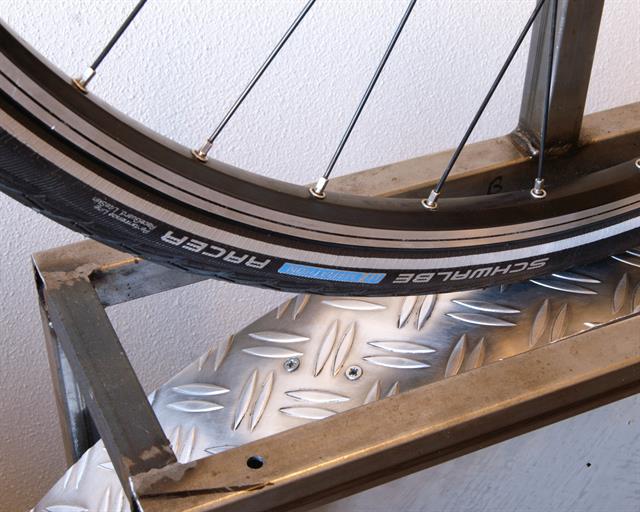
The Schwalbe Marathon Racer is the lightest member of the Marathon family and its name suggests this to be a very fast tire. The Marathon Racer has a 67 TPI carcass, SpeedGrip compound, RaceGuard puncture protection and LiteSkin sidewalls. Unlike the Marathon and Marathon Plus, the Racer doesn't have a thick and heavy anti-puncture layer under the tread. On paper, the Racer should have a much lower rolling resistance than both the Marathon and Marathon Plus.
Ad Buy Schwalbe Marathon Racer at Amazon.com
Specified weight of the Marathon Racer is just 465 grams, this makes it a lot lighter than the Marathon which has a specified weight of 730 grams. The biggest savings seem to be in the anti-puncture protection. The Racer uses a double layer of thin nylon fabric instead of the 3 or 5 mm thick latex layer the other Marathon tires use. Natural thinking suggests lower weight = lower rolling resistance... Let's just run the tests and find out if this is true.
Manufacturer Specifications
| Manufacturer Specs | |
|---|---|
| Brand | Schwalbe |
| Model | Marathon Racer |
| Year | 2015 |
| Supplied By | Supplied by Schwalbe |
| New or Used | New |
| Mileage | 0 km |
| Price Range | Med |
| Buy At | Ad Amazon.com |
| Manufacturer part number | 11100290 |
| TPI | 67 |
| Compound | SpeedGrip |
| Bead | Wire |
| ETRTO | 35-622 |
| Specified Weight | 465 grams |
| Max Air Pressure (psi) | 95 |
| Made In | Pro Data |
| Available Sizes |
40-622 (28x1.50) 35-622 (28x1.35) 30-622 (28x1.20) 40-559 (26x1.50) 40-406 (20x1.50) 40-355 (18x1.50) 40-305 (16x1.50) |
Schwalbe Marathon Racer 35 Test Results
Size, Weight, and Thickness Measurements
| Size, Weight, and Thickness Measurements | |
|---|---|
| Specified Weight | 465 grams |
| Measured Weight | 450 grams |
| Measured Width Casing | 33 mm (un-round) |
| Measured Width Tread | mm |
| Measured Height | Pro Data |
| Tire Circumference | Pro Data |
| Measured Knob Height Center | 0.0 mm |
| Measured Knob Height Edge | 0.0 mm |
| Measured Total Thickness Center (excluding knobs) | 4.60 mm |
| Measured Total Thickness Sidewall | Pro Data |
| All size measurements are taken at high air pressure on a 18 mm inner width rim. | |
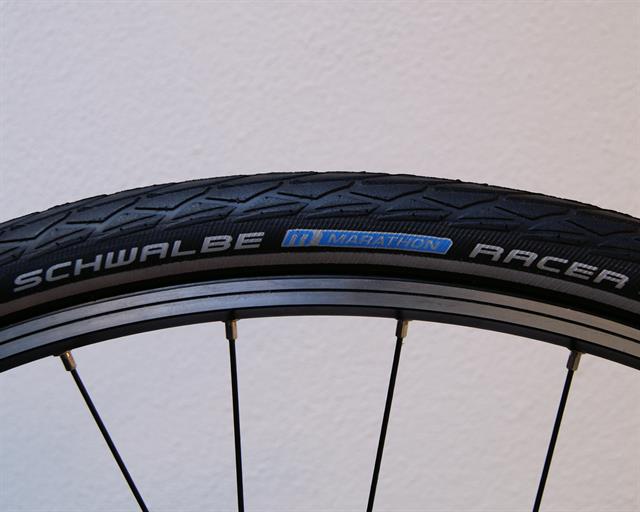
As previously mentioned, specified weight is 465 grams, my sample comes in even lower at 447 grams. The measured width and height is 33 mm and 32 mm respectively. Width and height both come in slightly below the rated size of 35-622.
Tread depth is 1.5 mm, which is less than both the Marathon (2.3 mm) (read review) and Marathon Plus (2.0 mm) (read review), but still reasonable. The Total Tire Thickness Tread measurements clearly show the Racer doesn't use a thick anti-puncture layer. With a total thickness of 4.6 mm, it's a much thinner tire than both the Marathon (7.3 mm) and Marathon Plus (9.0 mm). At 0.8 mm thickness, the sidewalls only have half the thickness of those tires.
Rolling Resistance Test Results
| Rolling Resistance Test Results | |
|---|---|
| Inner Tube | Conti Tour 28 (170 gr butyl) |
| Measured Width | 33 mm |
| Rolling Resistance Real tire width in mm: 30-32 = 66 psi/4.6 bar 33-35 = 60 psi/4.1 bar 36-38 = 54 psi/3.7 bar 39-42 = 50 psi/3.4 bar 43-46 = 46 psi/3.2 bar 47-50 = 42 psi/2.9 barHigh Air Pressure (60 psi / 4.1 bar) |
Pro Data |
| Rolling Resistance Real tire width in mm: 30-32 = 55 psi/3.8 bar 33-35 = 50 psi/3.4 bar 36-38 = 45 psi/3.1 bar 39-42 = 42 psi/2.9 bar 43-46 = 38 psi/2.6 bar 47-50 = 35 psi/2.4 barMedium Air Pressure (50 psi / 3.4 bar) |
Pro Data |
| Rolling Resistance Real tire width in mm: 30-32 = 44 psi/3.0 bar 33-35 = 40 psi/2.8 bar 36-38 = 36 psi/2.6 bar 39-42 = 33 psi/2.3 bar 43-46 = 31 psi/2.1 bar 47-50 = 28 psi/1.9 barLow Air Pressure (40 psi / 2.8 bar) |
31.4 Watts CRR: 0.00941 |
| Rolling Resistance Real tire width in mm: 30-32 = 33 psi/2.3 bar 33-35 = 30 psi/2.1 bar 36-38 = 27 psi/1.9 bar 39-42 = 25 psi/1.7 bar 43-46 = 23 psi/1.6 bar 47-50 = 21 psi/1.4 barExtra Low Air Pressure (30 psi / 2.1 bar) |
Pro Data |
| The CX/Gravel section is a multi tire size section, air pressures have been adjusted to the measured casing width. All numbers are for a single tire at a speed of 29 km/h / 18 mph and a load of 42.5 kg / 94 lbs. Use the formula: RR (Watts) = CRR * speed (m/s) * load (N) to calculate rolling resistance at a given speed and load. |
|
Shockingly, rolling resistance of the Marathon Racer is HIGHER than the plain Marathon with 3 mm thick anti-puncture layer and much higher weight. The Racer is also only barely able to outperform the 'flat-less' Marathon Plus. On average, rolling resistance is some 3 - 5 watts higher when compared to the plain Marathon and 0 - 1 watt lower when compared to the Plus.
I'm really disappointed by the performance of the Racer in the rolling resistance test, it's quite misleading to call this tire Racer when it's slower than the plain Marathon. Only providing a lower weight shouldn't justify the name Racer, rolling resistance should at least be on par with the plain Marathon.
Puncture Resistance Test Results
| Puncture Resistance Test Results (higher is better) | |
|---|---|
| Total Puncture Score Tread | 97 Points |
| Total Puncture Score Sidewall | Pro Data |
| Tread Puncture Force Sharp Needle | 16 |
| Tread Puncture Force Blunt Needle | Pro Data |
| Tread Total Tire Thickness | 4.60 mm |
| Sidewall Puncture Force Sharp Needle | Pro Data |
| Sidewall Puncture Force Blunt Needle | Pro Data |
| Sidewall Total Tire Thickness | Pro Data |
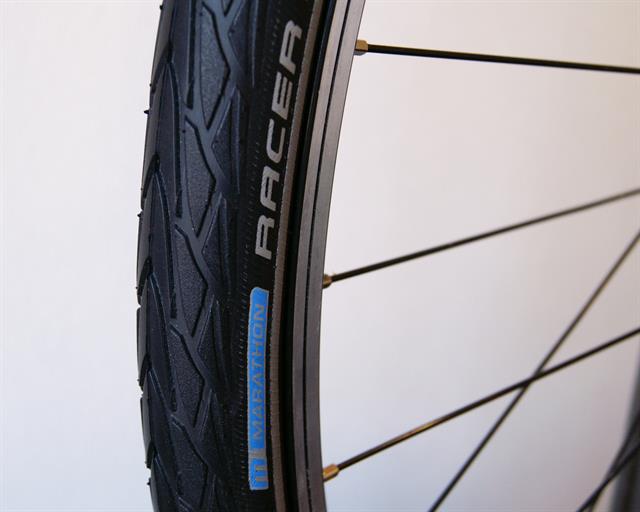
How does the double layer of thin nylon compare to the to the thicker anti-puncture layers of the Marathon and Marathon Plus? The Racer sets a higher score in the raw puncture resistance test than both those tires. With a score of 16 points, this is 2 points higher than the Marathon and 3 points higher than the Plus. In the sidewall test, the Racer scores 4 points vs 5 points for both the plain and Plus Marathon.
Because both the tread area and sidewall of the Racer are very thin, it doesn't do so well in the Puncture Factor calculation. Puncture Factor Tread comes to 72 points, which is still a decent score. Because the sidewalls only have a thickness of 0.8 mm, the Puncture Factor Sidewall calculation comes down to only 3 points. 3 points is very low, the Racer is the lowest scoring tire in the Puncture Factor Sidewall calculation to date.
Hard Surface Static Grip Test Results
| Static Grip Test Results | |
|---|---|
| Wet Grip Average | No Data |
| Wet Grip Center | No Data |
| Wet Grip Edge | No Data |
| Measured Knob Height Center | 0.0 mm |
| Measured Knob Height Edge | 0.0 mm |
| Grip in points = coefficient of friction * 100 CX/Gravel grip test rim width = 23.0 mm |
|
| Wet Grip Test and Off-Road Tires (info) | |
Conclusion
- Schwalbe Marathon Racer 35
(100% is fastest - lightest - thickest - strongest)
After testing the Marathon Racer, it leaves a bad taste. Because this is the 'Racer' version of the Marathon, I expected this tire to outperform the Marathon by at least a couple of watts in the rolling resistance test. An interesting theory could be that the Marathon and Marathon Plus are just too good. Those tires sell a lot more, which means more R&D resources and better materials are available to improve those tires.
If you don't mind the extra weight, just grab a pair of Marathon (GreenGuard) (read review) and have better performance in both the rolling resistance and puncture resistance department. Because the performance of the Schwalbe Marathon Racer is still equal or better than tires from other manufacturers, it gets a Recommended 3/5 rating.
Ad Buy Schwalbe Marathon Racer at Amazon.com
RATING:
3.0
/ 5
TEST VERDICT:
Recommended