
CX/Gravel Tire Test: Schwalbe Kojak 35
Contents and Test Summary
- Introduction
- Manufacturer Specifications
- Size, Weight, Thickness
- Rolling Resistance: 31.3 Watts
- Puncture Resistance: 67 Points
- Static Wet Grip: 74 Points
- Conclusion: 2.0 / 5 Not Recommended
- Comments
- Schwalbe Kojak 35
(100% is best)
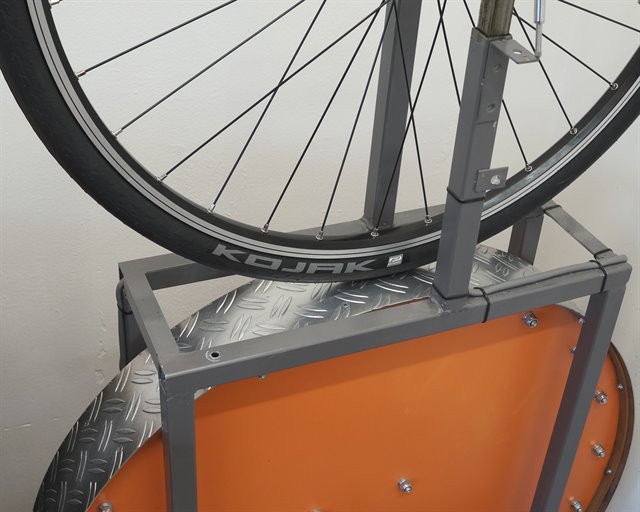
The Schwalbe Kojak is a "Performance Line" slick tire that's available for a decent price but doesn't use Schwalbe's most advanced technologies found in their "Evolution Line" tires. The Kojak is available as both a wire bead and a lighter folding version. Both the folding and wire bead versions use a 67 TPI casing, SpeedGrip compound, and RaceGuard puncture protection. I'm testing the 35-622 folding version of the Kojak.
Ad Buy Schwalbe Kojak at Amazon.com
The Kojak is a popular tire as it's a slick tire that's available for many different wheel sizes. The Kojak also comes in bigger sizes (32 - 50 mm) which isn't the case for most high-performance road bike tires that max out at 28 mm wide. I've often seen the Kojak recommend to people that are looking for a fast, slick tire to replace their MTB or touring bike tires. I totally understand why people recommend the Kojak as it looks blistering fast on an off the bike, but is it really faster than the tires you're replacing?
Manufacturer Specifications
| Manufacturer Specs | |
|---|---|
| Brand | Schwalbe |
| Model | Kojak |
| Year | 2017 |
| Supplied By | Bought in store |
| New or Used | New |
| Mileage | 0 km |
| Price Range | Med |
| Buy At | Ad Amazon.com |
| Manufacturer part number | 11600020.01 |
| TPI | 67 |
| Compound | SpeedGrip |
| Bead | Folding |
| ETRTO | 35-622 |
| Specified Weight | 330 grams |
| Max Air Pressure (psi) | 95 |
| Made In | Pro Data |
| Available Sizes |
32-355 (18x1.25) 32-369 (27x1 1/4) 35-406 (20x1.35) 35-559 (26x1.35) 50-559 (26x2.00) 35-622 (28x1.35) |
Schwalbe Kojak 35 Test Results
Size, Weight, and Thickness Measurements
| Size, Weight, and Thickness Measurements | |
|---|---|
| Specified Weight | 330 grams |
| Measured Weight | 351 grams |
| Measured Width Casing | 33 mm (un-round) |
| Measured Width Tread | mm |
| Measured Height | Pro Data |
| Tire Circumference | Pro Data |
| Measured Knob Height Center | 0.0 mm |
| Measured Knob Height Edge | 0.0 mm |
| Measured Total Thickness Center (excluding knobs) | 3.90 mm |
| Measured Total Thickness Sidewall | Pro Data |
| All size measurements are taken at high air pressure on a 18 mm inner width rim. | |
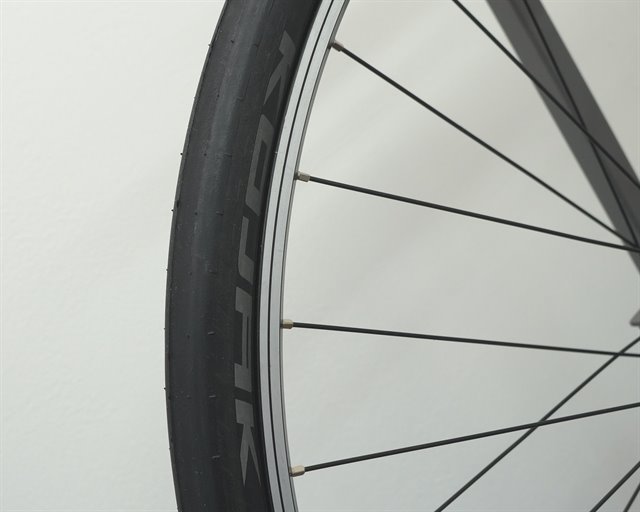
The specified weight of the (folding bead) 35-622 Schwalbe Kojak is 330 grams; my sample is a bit heavier at 351 grams. On my 17 mm wide rim (internal), at an air pressure of 60 psi / 4.1 bars, the Kojak has a maximum width of 33 mm and a maximum height of 31 mm.
The total thickness of the tire at the center of the tread is 3.9 mm. 3.9 mm is a bit less than most touring bike tires without thick anti-protection layers which generally have a thickness of 4 - 5 mm. It does is much thicker than most high-performance road bike tires that mostly have a tread thickness of less than 3 mm. The higher thickness means the Kojak should last much longer. The Kojak's sidewalls have a thickness of 0.55 mm which is extremely thin for a touring bike class tire. If you need strong sidewalls, this isn't your tire.
Rolling Resistance Test Results
| Rolling Resistance Test Results | |
|---|---|
| Inner Tube | Conti Tour 28 (170 gr butyl) |
| Measured Width | 33 mm |
| Rolling Resistance Real tire width in mm: 30-32 = 66 psi/4.6 bar 33-35 = 60 psi/4.1 bar 36-38 = 54 psi/3.7 bar 39-42 = 50 psi/3.4 bar 43-46 = 46 psi/3.2 bar 47-50 = 42 psi/2.9 barHigh Air Pressure (60 psi / 4.1 bar) |
Pro Data |
| Rolling Resistance Real tire width in mm: 30-32 = 55 psi/3.8 bar 33-35 = 50 psi/3.4 bar 36-38 = 45 psi/3.1 bar 39-42 = 42 psi/2.9 bar 43-46 = 38 psi/2.6 bar 47-50 = 35 psi/2.4 barMedium Air Pressure (50 psi / 3.4 bar) |
Pro Data |
| Rolling Resistance Real tire width in mm: 30-32 = 44 psi/3.0 bar 33-35 = 40 psi/2.8 bar 36-38 = 36 psi/2.6 bar 39-42 = 33 psi/2.3 bar 43-46 = 31 psi/2.1 bar 47-50 = 28 psi/1.9 barLow Air Pressure (40 psi / 2.8 bar) |
31.3 Watts CRR: 0.00938 |
| Rolling Resistance Real tire width in mm: 30-32 = 33 psi/2.3 bar 33-35 = 30 psi/2.1 bar 36-38 = 27 psi/1.9 bar 39-42 = 25 psi/1.7 bar 43-46 = 23 psi/1.6 bar 47-50 = 21 psi/1.4 barExtra Low Air Pressure (30 psi / 2.1 bar) |
Pro Data |
| The CX/Gravel section is a multi tire size section, air pressures have been adjusted to the measured casing width. All numbers are for a single tire at a speed of 29 km/h / 18 mph and a load of 42.5 kg / 94 lbs. Use the formula: RR (Watts) = CRR * speed (m/s) * load (N) to calculate rolling resistance at a given speed and load. |
|
Rolling resistance of the Kojak is a BIG disappointment. The Kojak looks fast, but it gets outperformed in the rolling resistance tests by "average" touring bike tires like the Schwalbe Marathon GreenGuard (read review) and Continental Contact (read review). When we look at the best performing tires in the touring bike category, rolling resistance of the Kojak is terrible. At an air pressure of 60 psi / 4.1 bars, rolling resistance of the Kojak comes in at 24.8 watts which is 7.5 watts more than the Schwalbe Marathon Almotion (read review) (17.1 watts -current fastest tire in touring bike category).
The Kojak is often recommended as a good upgrade to people that mainly use their mountain bike as a road bike. Please check the MTB overview page and be aware that a large part of the MTB tires actually have a lower rolling resistance than the Kojak!
What can we learn from this test? It's impossible to predict the rolling resistance of tires by just looking at them. Be careful your "upgrade" doesn't turn out to become a downgrade.
Puncture Resistance Test Results
| Puncture Resistance Test Results (higher is better) | |
|---|---|
| Total Puncture Score Tread | 67 Points |
| Total Puncture Score Sidewall | Pro Data |
| Tread Puncture Force Sharp Needle | 12 |
| Tread Puncture Force Blunt Needle | Pro Data |
| Tread Total Tire Thickness | 3.90 mm |
| Sidewall Puncture Force Sharp Needle | Pro Data |
| Sidewall Puncture Force Blunt Needle | Pro Data |
| Sidewall Total Tire Thickness | Pro Data |
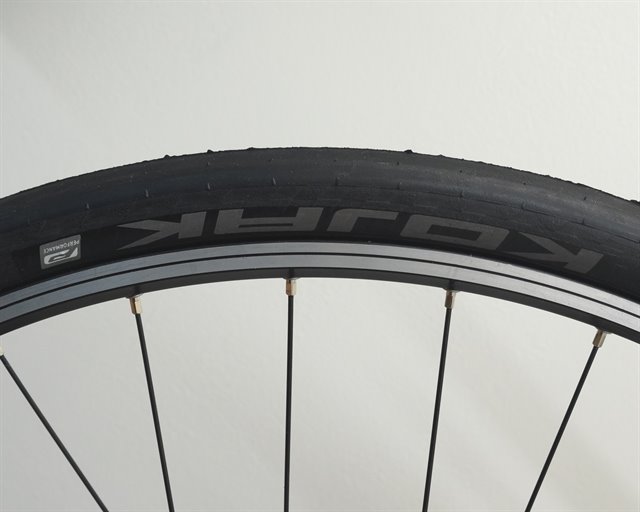
In the puncture resistance tests, the Kojak scores very low when compared to touring bike tires. In the tread puncture test, it scores 12 points which is decent but on the low side. In the sidewall puncture test, performance is horrible with a Puncture Factor score of just 2 points. If you need any sidewall protection, this isn't your tire.
Hard Surface Static Grip Test Results
| Static Grip Test Results | |
|---|---|
| Wet Grip Average | 74 Points |
| Wet Grip Center | Pro Data |
| Wet Grip Edge | Pro Data |
| Measured Knob Height Center | 0.0 mm |
| Measured Knob Height Edge | 0.0 mm |
| Grip in points = coefficient of friction * 100 CX/Gravel grip test rim width = 23.0 mm |
|
| Wet Grip Test and Off-Road Tires (info) | |
Conclusion
- Schwalbe Kojak 35
(100% is fastest - lightest - thickest - strongest)
If a tire looks fast, it doesn't mean it actually is a fast tire. The Schwalbe Kojak looks like a high-performance slick road bike tire, but our tests show rolling resistance is actually higher than an average touring bike tire like the Schwalbe Marathon GreenGuard (read review). On top of the high rolling resistance, puncture resistance is much lower than real touring bike tires. The low weight and decent price are the only positives I can think of.
If you're looking for really fast slick tires, I recommend taking a look at the 28 mm versions of popular road bike tires like the Continental Grand Prix 4000S II (read review) and Schwalbe One (read review). These tires are just a little bit smaller than the Kojak, but perform much better. For 26-inch bikes, the regular Continental Grand Prix (read review) might be worth a look as it's available in 28 mm for 26-inch rims.
Ad Buy Schwalbe Kojak at Amazon.com
RATING:
2.0
/ 5
TEST VERDICT:
Not Recommended